Visioconférence / Cécile LAYE, Paris / Playford 1651 ... et plus ! (2/3) / Online lecture
 

Résultat de recherche d'images pour

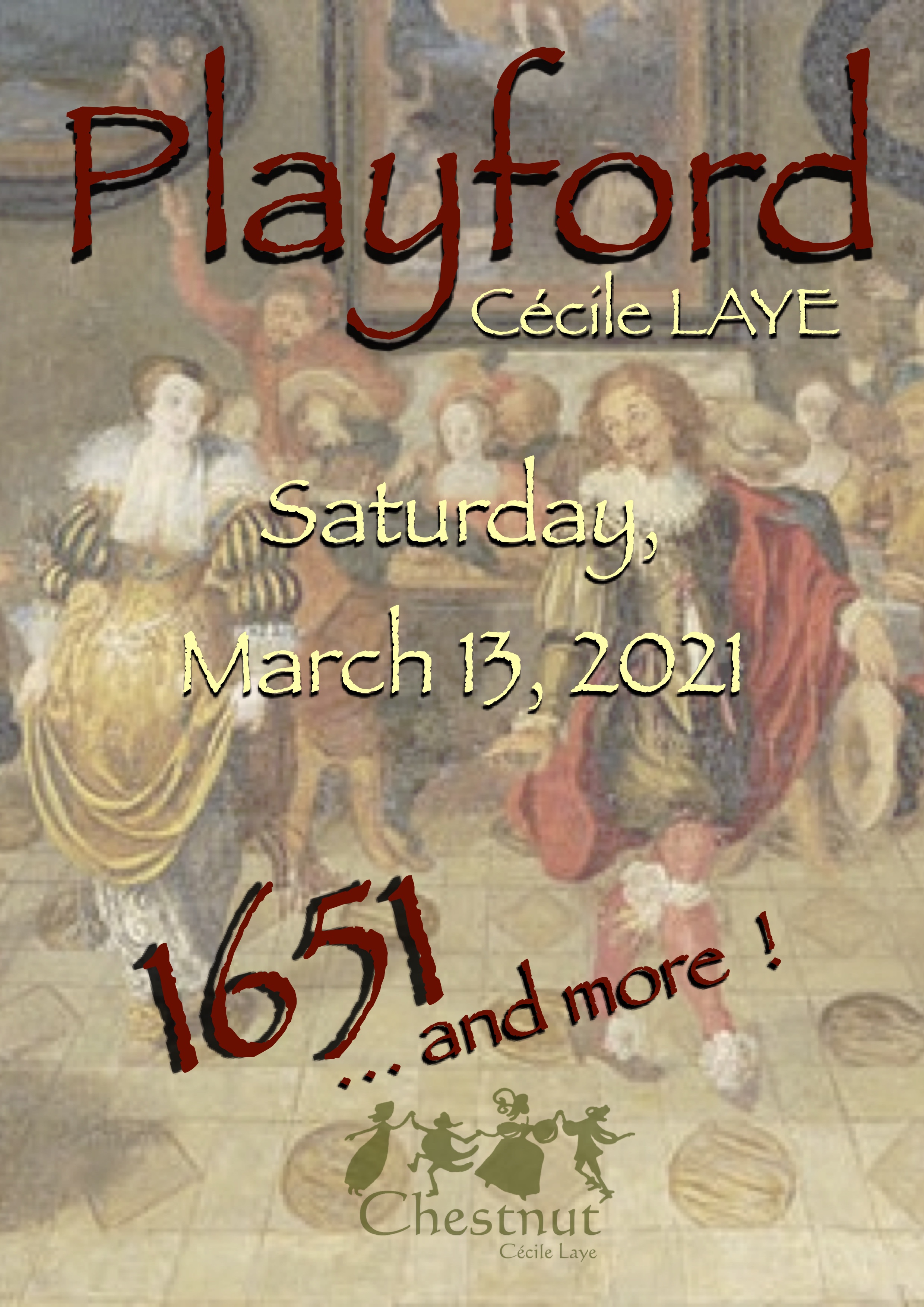
Playford 1651 ... et plus ! est une conférence en trois parties ayant pour objectif d'apporter aux danseurs un éclairage théorique sur leur pratique des danses à figures anglaises.

La deuxième partie en français (2/3) sera donnée le samedi 27 mars 2021 de 18h00 à 19h30 (heure de Paris).

The lecture will be given in French. At other proposed dates, it will be spoken in English. First part (1/3) in English : Saturday, March 13, 2021 


Au programme de cette deuxième partie : 

Cécile Laye nous aidera en s'inspirant du mémoire qu'elle a écrit pour le centre Centre National de la Danse à comprendre comment et à partir de quoi une danse de John Playford se structure.  Nous verrons plusieurs vidéos filmées.

Il est possible d'assister à cette 2ème causerie même si on n'a pas assisté à la première.

---> Inscription : ici  <---


Cécile LAYE étudie les danses historiques en Angleterre avec la Dolmetsch Historical Danse Society, Nonsuch History and Dance et la EFDSS (English folk Dance and Song Society). Elle a en particulier l’occasion de travailler sous la direction de pédagogues ou de chercheurs éminents tels que Anne Daye, Anne Cottis, Peggy Dixon, Ethyl Anderson, Marjorie Fennessy, Tom Cook et Alan Davies. En France, elle étudie avec Francine Lancelot, Andréa Francalancci et Barbara Sparti. En 1998, elle fonde la compagnie CHESTNUT pour faire découvrir et aimer au public français le répertoire des danses à figures anglaises qu’elle s’applique à replacer dans le continuum historique chorégraphique européen.  Formée à la comédie et à la mise en scène au Cours Florent dont elle est diplômée, elle s’attache aussi à mettre en rapport le répertoire anglais avec certains aspects de l’histoire et de la littérature britannique. 

Chestnut Cécile Laye

Elle enseigne en France, en Belgique, en Angleterre et au Amherst Early Music Festival aux Etats-Unis. Elle obtient en 2016, l’Aide à la Recherche et au Patrimoine en Danse du Centre National de la danse pour constituer une typologie des danses de la 1ère édition de l’English Dancing Master.


Cécile LAYE is CHESTNUT’s artistic director.

She studied old dance forms in England with the Dolmetsch Historical Dance Society,  Nonsuch History and Dance and EFDSS (English folk Dance and Song Society). She worked in particular under such famed teachers and researchers as  Anne Daye, Anne Cottis, Peggy Dixon, Ethyl Anderson, Marjorie Fennessy, Tom Cook and Alan Davies. In France she studied with Francine Lancelot, Andréa Francalancci and Barbara Sparti.

At the end of the eighties, she founded AMARILLIS, a dance company meaning to bring to the public figure dances of the Stuarts’ time and the English inheritance, as well as some aspects of history and literature, with the collaboration of musicians and singers. AMARILLIS was replaced by CHESTNUT in 1998. CHESTNUT took over its predecessor’s artistic activities (creating dance and theatre shows), its teaching (preparing dancers for Balls through a rich program of workshops and classes) and its publication ones (CDs, dance descriptions, articles on Playford and modern dances).

Over the years, Cécile LAYE has build up a strong experience as a dancing master and ball caller (French Renaissance balls/ English figure dances balls, or a mixture of both). She can pass on her taste for and pleasure in elegant dancing to beginners as well as seasoned dancers.

Besides her activities in the field of dancing, Cécile Laye studied dramatic art and staging, graduating at Cours Florent. She also graduated at Eva Ruchpaul’s Yoga Institute and the Paris school of Gestalt-therapy. She played Shakespeare, Molière and Marivaux in Paris and elsewhere in France and takes part in creating new plays and shows, for children in particular.

She draws on both sides of her extensive training, physical and artistic, to develop her teaching method.

Her constant aim is to understand the needs of a given group and of each person making up the group, to build up a class so that each person gradually understands the dance, becomes aware of his/her body and its expressive capacities, be it during a lesson, a ball, or on stage.

  • Conference
  • Playford
  • All levels

Online lecture / Cécile LAYE, Paris / Playford 1651 ... and more ! (1/3)


Résultat de recherche d'images pour


First (1/3) in a serie of three talks given in English and devoted to the repertoire of 17th Century English figure dances and its reference text.

After the generalities of use and the reminder of the historical context, I propose to guide you step by step through the English Dancing Master.

In this first talk program: 

  1. – Generalities
  2. – Historical background
  3. – False leads
  4. – Let’s open the book: orientation, numbering, proper and improper, music, …
  • In the 2nd talk (2/3), I will use my ranking work done with the CND (National Dance Center in Paris) to do a structural study of the 1st edition dances starting with the Measure.
  • In the last talk (3/3), I would like to mention the Revival movement for dance and its head figure, Cecil Sharp.

Cécile Laye's talk "Playford 1651 ... and more !" (1/3) in English

Saturday, March 13, 2021 

(France : 19h30 / UK : 6.30 pm / USA : 1.30 pm East ST / USA : 10.30 am  Pacific ST)

Registration: here

---> Please note: registration will be definitively closed on 03/12/2021 at 22:00 (Paris time)


Chestnut Cécile Laye

Cécile LAYE is CHESTNUT’s artistic director.

She studied old dance forms in England with the Dolmetsch Historical Dance Society,  Nonsuch History and Dance and EFDSS (English folk Dance and Song Society). She worked in particular under such famed teachers and researchers as  Anne Daye, Anne Cottis, Peggy Dixon, Ethyl Anderson, Marjorie Fennessy, Tom Cook and Alan Davies. In France she studied with Francine Lancelot, Andréa Francalancci and Barbara Sparti.

At the end of the eighties, she founded AMARILLIS, a dance company meaning to bring to the public figure dances of the Stuarts’ time and the English inheritance, as well as some aspects of history and literature, with the collaboration of musicians and singers. AMARILLIS was replaced by CHESTNUT in 1998. CHESTNUT took over its predecessor’s artistic activities (creating dance and theatre shows), its teaching (preparing dancers for Balls through a rich program of workshops and classes) and its publication ones (CDs, dance descriptions, articles on Playford and modern dances).

Over the years, Cécile LAYE has build up a strong experience as a dancing master and ball caller (French Renaissance balls/ English figure dances balls, or a mixture of both). She can pass on her taste for and pleasure in elegant dancing to beginners as well as seasoned dancers.

Besides her activities in the field of dancing, Cécile Laye studied dramatic art and staging, graduating at Cours Florent. She also graduated at Eva Ruchpaul’s Yoga Institute and the Paris school of Gestalt-therapy. She played Shakespeare, Molière and Marivaux in Paris and elsewhere in France and takes part in creating new plays and shows, for children in particular.

She draws on both sides of her extensive training, physical and artistic, to develop her teaching method.

Her constant aim is to understand the needs of a given group and of each person making up the group, to build up a class so that each person gradually understands the dance, becomes aware of his/her body and its expressive capacities, be it during a lesson, a ball, or on stage.

  • Conference
  • Playford
  • All levels

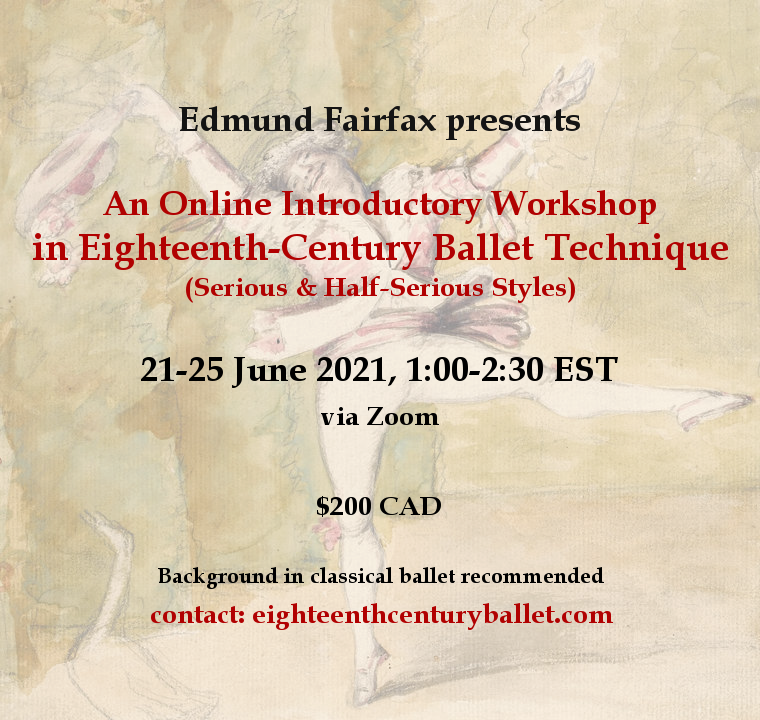
Online Introductory Workshop in Eighteenth-Century Ballet Technique

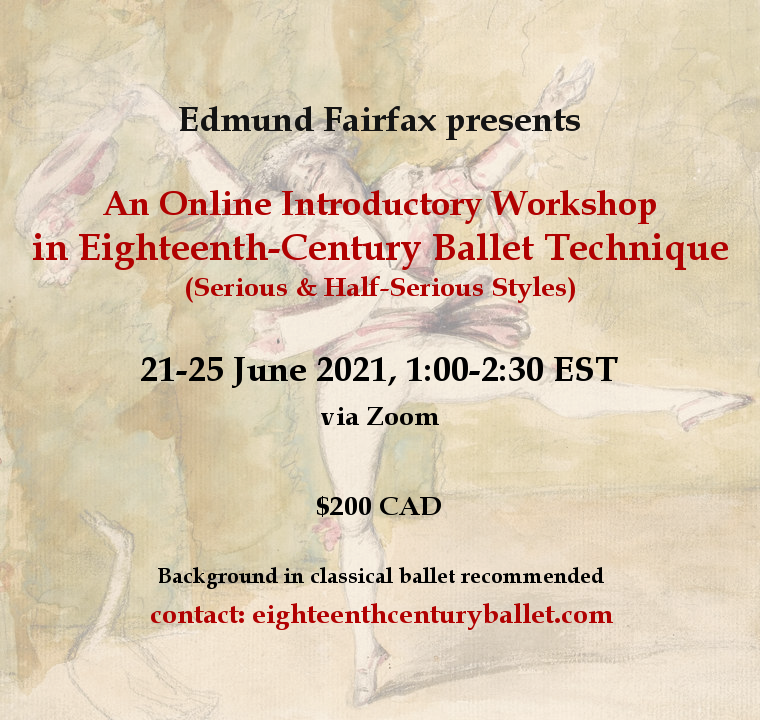
This is a practical introductory workshop in eighteenth-century ballet technique, focusing on the serious and half-serious styles. The fundamentals of the technique (positions, constituent movements, orientations) will be presented, and the student will be systematically guided through a number of composite steps and their variants. The differences between the technique of the ballroom and that of the stage will be stressed, and entrenched misconceptions addressed. It is recommended that the student have some background in classical ballet, but the event is open to all. The workshop is led by Edmund Fairfax (author of _The Styles of Eighteenth-Century Ballet_ (2003)), and the material presented is based on his extensive research into this topic. See also his website: eighteenthcenturyballet.com.

  • Workshop
  • Baroque
  • All levels

All’Italiana - alla Spagnuola. 17th century early dance

Eine Woche, die Sie nicht verpassen sollten.
Bitte mitbringen: Kastagnetten / Charakter-Tanzschuhe mit einem kleinen Absatz für Canario und Zapateado

Wir füllen unsere Abende mit Gesellschaftstänzen, Tanzvideos und Vorträgen. Daneben probieren wir an einem Abend leckere Weine aus der Region in einem Weingut.

Was bedeutet das?

Spiegelt es etwas in der Musik wider oder können wir über typisch spanische oder italienische Schritte sprechen?

Nur wenige Menschen wissen, dass die Abhandlung „Le Gratie d’Amore“ von Negri auch ins Spanische übersetzt wurde, da sein Buch dem spanischen König Philip III gewidmet
war. Das Manuskript blieb unveröffentlicht und kann (digital) in der französischen Nationalbibliothek eingesehen werden. Wir möchten Euch einen aufregenden Kurs mit Jaime Puente und Lieven Baert anbieten, in dem Ihr Tanz im spanischen Stil lernen könnt.

Wir werden am Vormittag neue Schritte aus der spanischen Folklore, die mit historischem Tanz verbunden sind, entdecken und lernen. Lieven Baert wird am Nachmittag an italienischen Tänzen arbeiten, beeinflusst von der spanischen Tanzkultur, hauptsächlich an Spagnoletto als unsere Inspiration.

Es wird ein fantastischer Kurs voller mediterraner Aromen, Schritte und Rhythmen. Wir werden die Woche aufgrund des großen Erfolges in den Vorjahren mit einem aufregenden Kochnachmittag und Abend im italienischen historischen und zeitgenössischen Stil beenden!

Ort: Jugendgästehaus auf dem Schönberg, 55430 Oberwesel
(https://www.diejugendherbergen.de/jugendherbergen/oberwesel/portrait/)

Zeit: SAMSTAG, 7. August 2021 bis SAMSTAG, 14. August 2021
Anreise bis 17:00 Uhr – Abreise bis 11:00 Uhr

Träger der Veranstaltung:
Katholische Erwachsenenbildung im Bistum Trier
KEB Bad Kreuznach, Bildungswerk Oberwesel
 

  • Course
  • Cinquecento
  • Spanish baroque
  • Advanced

Online Lecture: Monika Ritthaler for un'altra volta: Improvising Historical Dance to Live Music - Enabling Dancers of Diverse Backgrounds to Create Historical Dances in Real Time: Project Description - Field Report - Outlook on the Minuet

Online Lectures on Practical Dance History of the 15th to 19th Centuries in 2021 – Munich Online Lectures on the History of Dance Practice


The Förderverein für historischen Tanz e.V. (Association for Supporting Historical Dance) in Munich invites interested persons to participate by Zoom in a 2021 Online Lecture on Practical Dance History:

Monika Ritthaler for un'altra volta: Improvising Historical Dance to Live Music - Enabling Dancers of Diverse Backgrounds to Create Historical Dances in Real Time: Project Description - Field Report - Outlook on the Minuet
Sunday, 27 February, 7pm


Those interested can request the Log-In information with Giles Bennett by email: gbdeat-foerderverein@yahoo.com.


-- Deutsche Version --

Online-Vorträge zur praktischen Tanzgeschichte des 15. bis 19. Jahrhunderts 2021 – Munich Online Lectures on the History of Dance Practice


Der Förderverein für historischen Tanz e.V. aus München lädt hiermit zu unserem ersten Online-Vortrag zur praktischen Tanzgeschichte in 2021 per Zoom ein:


Monika Ritthaler for un'altra volta: Improvising Historical Dance to Live Music - Enabling Dancers of Diverse Backgrounds to Create Historical Dances in Real Time: Project Description - Field Report - Outlook on the Minuet

Samstag, 27. Februar, 19 Uhr


Interessenten können die Einwahldaten bei Giles Bennett über die Emailadresse gbdeat-foerderverein@yahoo.com erfragen.


  • Conference
  • Renaissance
  • Baroque
  • Rococo
  • All levels

Intermediate 15th century dance class series

Would you like to advance your medieval dance skills and learn more complex dances? Then join my workshop series and dance away with grace along with a new advanced choreography every week.

Schedule:   February 13: Prexonera February 21: Fia Guielmina March 6: Leoncello March 14: Gioioso in tre   Cost: $3 per person per class   Where: Zoom  When: Various dates Time: 12:15-13:15 MST (GMT-7)

Registration: https://forms.gle/iecTn7d2UEdnwHgM8

  • Course
  • Quattrocento
  • Intermediates
  • Advanced

Beginner 15th century dance series

Would you like to explore graceful social dance from the bygone era of the great medieval and Renaissance courts? Have no real experience, or wish to review fundamental footwork and techniques and learn some "new" dances? Then join my workshop series and walk away with a fundamental grasp of both the basics along with a new dance every week. Schedule:     February 13: Petite Rose February 21: Filles a marier February 28: Amoroso (both versions) March 6: Grene Gynger & Orynge March 14: Bassadanza Gioliva     Cost: $3 per person per class   Where: Zoom  When: Various dates Time: 11:00 AM -12:00 PM MST (GMT-7)

Registration: https://forms.gle/17LnuWhXYaNixU2X8

  • Course
  • Quattrocento
  • All levels