Carola Finkel
ducdebreme

Baroque Dance Workshops: Steps in Context
A mix of Technique, Notation Reconstruction and Presentation Skills dances, you don't need to be able to read notation for these classes but a copy of the notation will be available for those interested.
Saturdays, 10:30am to 5:00pm (UK time)
April 17th; May 15th; June 26th; July 17th; August 7th.
Session 1: 10:30am - 1:15pm; All levels, beginners welcome
Session 2: 2:15pm - 5:00pm; Intermediate/Advanced, no beginners
Payment can be made in GB pounds, Euros or US Dollars, by UK cheque, PayPal or bank transfer.
For further information, please contact Philippa: philippa@ukbaroquedance.com
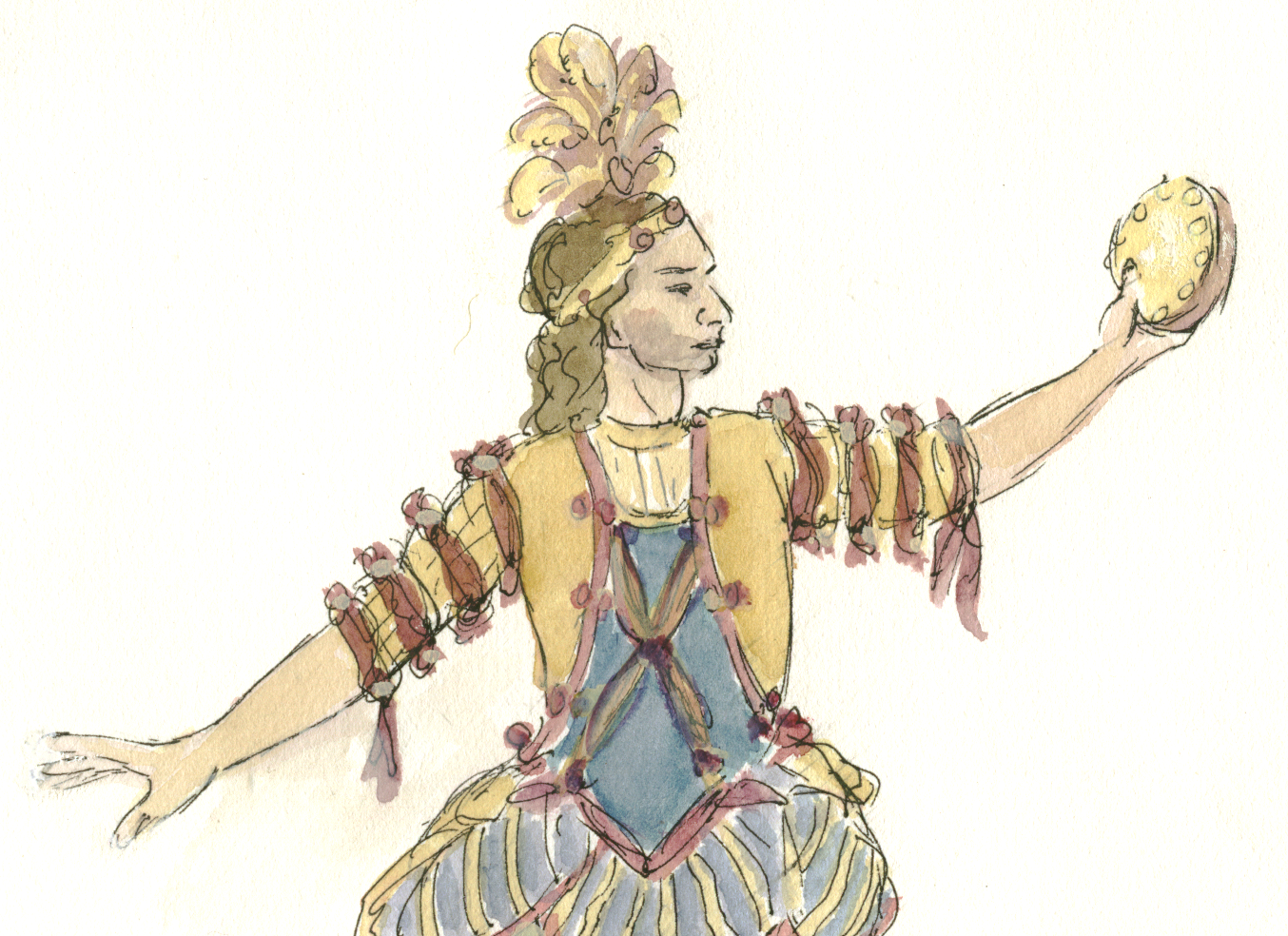
Baroque Dance Technique classes with Philippa Waite
Friday evenings, 6.00pm - 9:30pm (UK time)
Session 1: 6:00pm - 8:00pm, Technique all levels, beginners welcome
Session 2: 8:15pm - 9:30pm, Technique intermediate/advanced, no beginners
April to July 2021 Series:
April 9th & 23rd; May 7th & 21st; June 4th & 18th, July 2nd, 16th, 30th.
Payment can be made in GB pounds, Euros and US Dollars, by UK cheque, PayPal or bank transfer.
For further information, please contact Philippa: philippa@ukbaroquedance.com
or
Dance Through the Ages
From the Middle Ages to the Early Twentieth Century, including The Elizabethan ans English Regency periods.
Wednesday evenings, 8:15 to 9:15pm (UK time)
April 14th & 28th; May 12th & 26th; June 9th & 23rd; July 7th & 21st; August 4th.
Payment can be made in GB pounds, Euros or US Dollars, by UK cheque, PayPal or bank transfer.
For further information please contact Philippa: philippa@ukbaroquedance.com
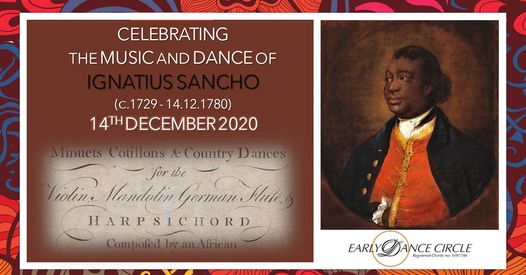
Sancho is famous nowadays as a man of letters and the first African to vote in a British election. But now you can look forward to reconstructions of Sancho’s choreographies and music by the Hampshire Regency Dancers, Quadrille Club and Green Ginger, as well as discussions and interviews with some knowledgeable experts on his career:
Meryl Thomson (Green Ginger), who recently recorded the CD “Dances for a Princess”. Paul Cooper, a specialist in Regency dance, who has worked a good deal on Sancho. Sally Petchey, author of a recent book about the life and dances of Ignatius Sancho: Dances for a Princess, humbly dedicated (with permission) to the Princess Royal by Her Royal Highnesses Most Obedient Servant Ignatius Sancho.
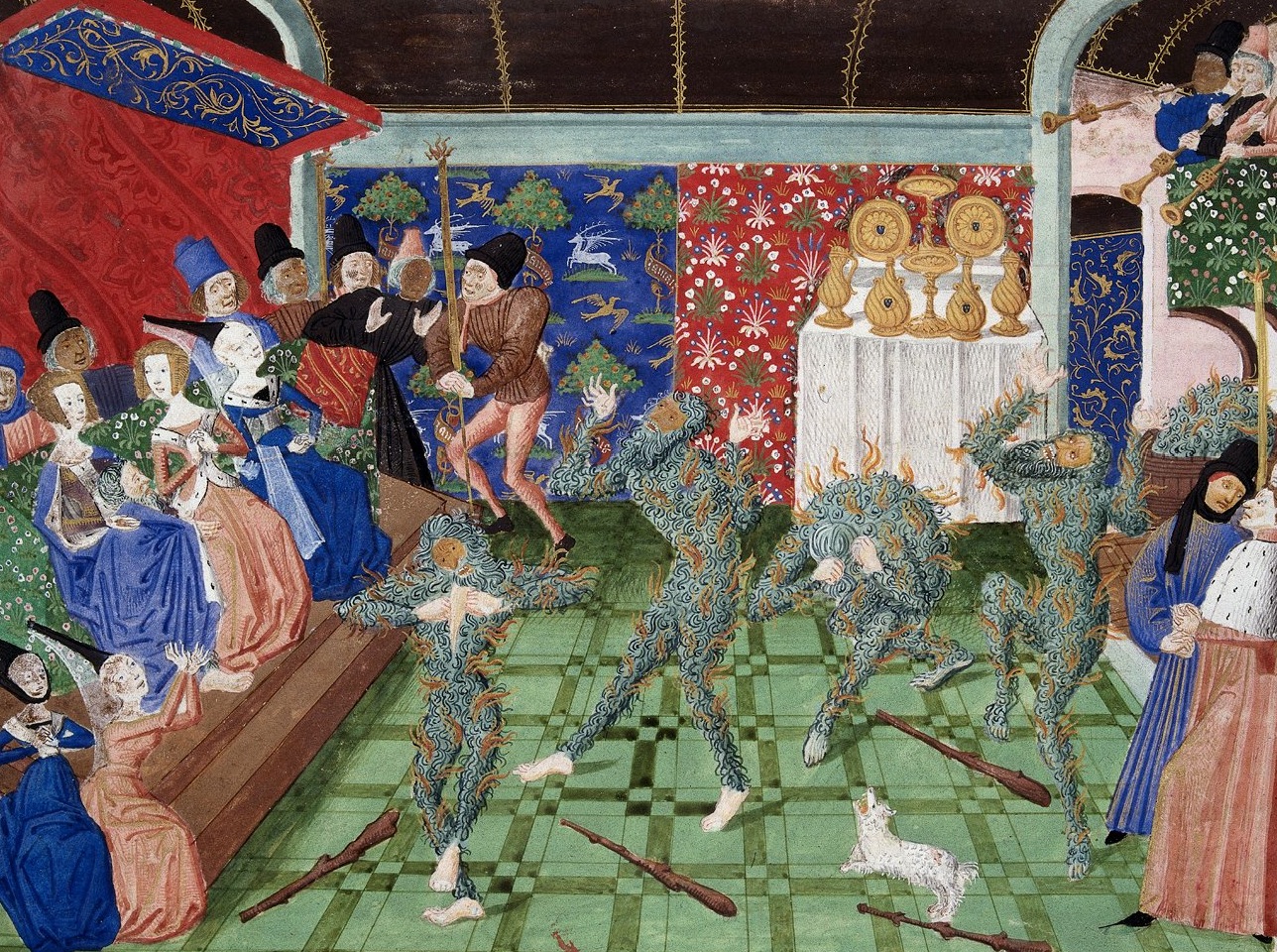
EDC ANNUAL LECTURE for 2021
BY ZOOM
Rehearsals, Performance Problems and Audience Reaction in Renaissance Spectacles
Speaker: Dr Jennifer Nevile
Honorary Senior Lecturer at the University of New South Wales and esteemed author of many books on Renaissance dance, including The Eloquent Body: Dance and Humanist Culture in Fifteenth-Century Italy (2004) and Dance, Spectacle and the Body Politick, 1250-1750 (2008) and very much else.
In Renaissance Europe theatrical spectacles performed in front of the monarch and court carried serious political messages regarding the relationship – both real and hoped for – between the monarch and the state. Contemporary accounts of these events often offer fulsome praise for the costumes, dancing, scenery, stage machines and songs. A successful performance greatly enhanced a country’s reputation on the international stage. Much more was at stake than an evening’s entertainment.
Yet then, as now, such multi-media events encountered problems, in rehearsal and performance. These form the focus of this paper, followed by an examination of the response of the spectators to such disasters. Did performance problems change the dynamics between performers and spectators? This is especially interesting when the king, queen or members of the ruling family were involved, either directly as dancers, or indirectly as the audience member to whom the spectacle was addressed.
The paper outlines the desire in European courts for great success, and what efforts went into achieving this, before recounting some of the disasters -- noise and over-crowding, stage-fright, properties too big to fit into the hall, and even fire. Finally, audience reactions are examined to such disasters, and the effects felt on the dynamics between audience and performers.
How to Book: Tickets are free via Eventbrite, with a suggested donation of £5 (or more). You can donate on Eventbrite or by sending a cheque to the secretary@earlydancecircle.co.uk. The booking link is https://tinyurl.com/EDCLecture2021. It is also on our Facebook page or at https://www.earlydancecircle.co.uk/events/
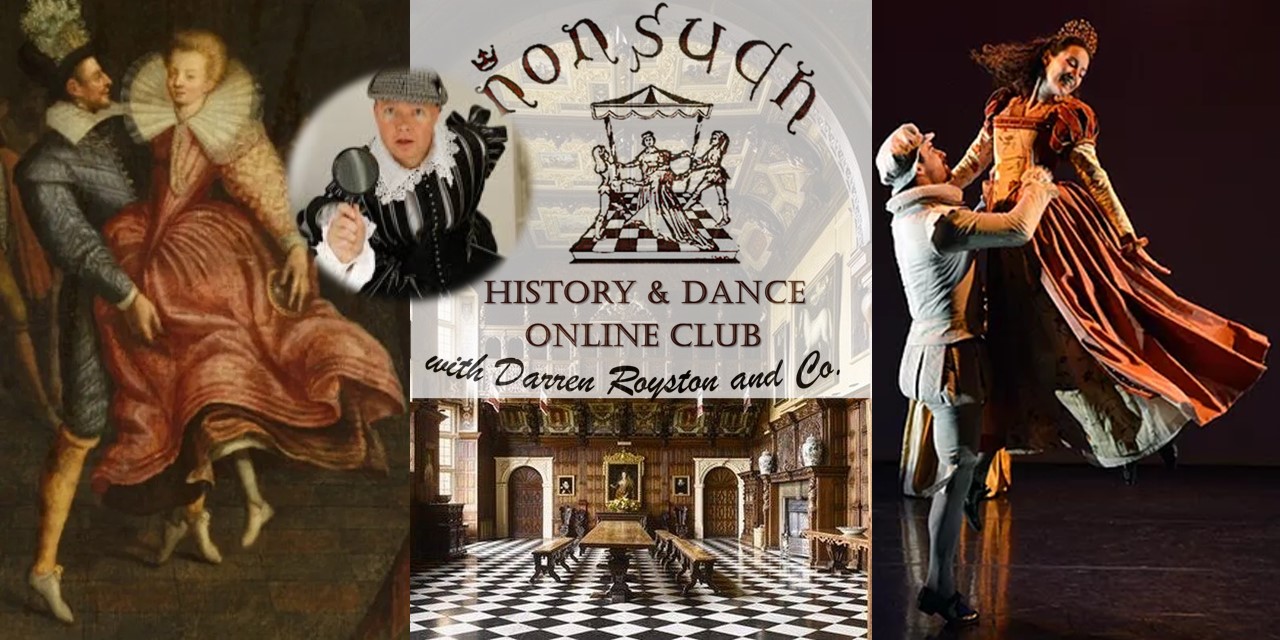
From Fall to Spring: six months for studying six centuries of dance!
Starting in October 2020!
Join Darren Royston, celebrated choreographer and teacher, for online sessions exploring historical dances from medieval periods to the nineteenth century.
Darren, together with guest teachers, artists, specialists, and friends, will recreate historical dance using music, paintings, costumes, history and drama from different periods.
From Fall to Spring will move through historical periods and learn the early dance essentials based on latest research and the Nonsuch repertoire, as published in Peggy Dixon’s “Dances from the Courts of Europe” and Darren Royston’s “Dramatic Dance.”
How the Online sessions work
Two hours dance classes including physical warm-ups, Laban-based movement training exercises, a historical dance technique class with a demonstration of original choreographies and finishing with a discussion as a chance to chat and socialise.
Intense dance instruction will take one hour of the two-hour session with the option to get a feedback from the instructor.
Sessions are open to beginners – as each class explores the basic of a historical style, with examples of the period, discussion of the art and people of the time.
Notes will be provided one week in advance before the class, and some preparation of reading, online surfing, listening to music, and studying dance and art samples is recommended between the classes.
HOW TO BOOK
Tickets are bookable from EVENTBRITE
Admission: £10 per class / £8 for Members of NONSUCH HISTORY AND DANCE
Membership of NONSUCH costs £18 per year.
Members will receive a code for reduction when booking.
Bursaries are also available: please contact NONSUCH for further details.
Contact: info@nonsuchdance.co.uk
2020 Series One (5 classes over 3 months)
SESSION 1 Sunday 25th October: Medieval Realms: Estampie & Basse Danse.
SESSION 2 Sunday 15th November: The Italian 15th Century Renaissance: the Dancing World of Leonardo da Vinci.
SESSION 3 Sunday 29th November: Elizabethan England and the Art of Orchesography: Lascivious La Voltas.
SESSION 4 Sunday 13th December: Renaissance Revels: 16th & 17th Centuries Italian Dances and the Jacobean Court.
SESSION 5 Sunday 27th December: Christmas is Restored: Revels for All
2021 Series Two (5 sessions over 3 months)
SESSION 6 Sunday 10th January: The King is Dancing: Dances from 1660 – 1715.
SESSION 7 Sunday 24th January: Enlightened Dance: Dances from 1715 – 1790, including Scottish Golden Age.
SESSION 8 Sunday 7th February: Jane Austen Dancing: Bouncing Cotillions!
SESSION 9 Sunday 21st February: Regency Ballroom: or the Art of being Improper.
SESSION 10 Sunday 7th March: Dancing with Queen Victoria: the Close Embrace.
SESSION 11 Sunday 21st March: THE FINAL “ONLINE” Spring Equinox BALL
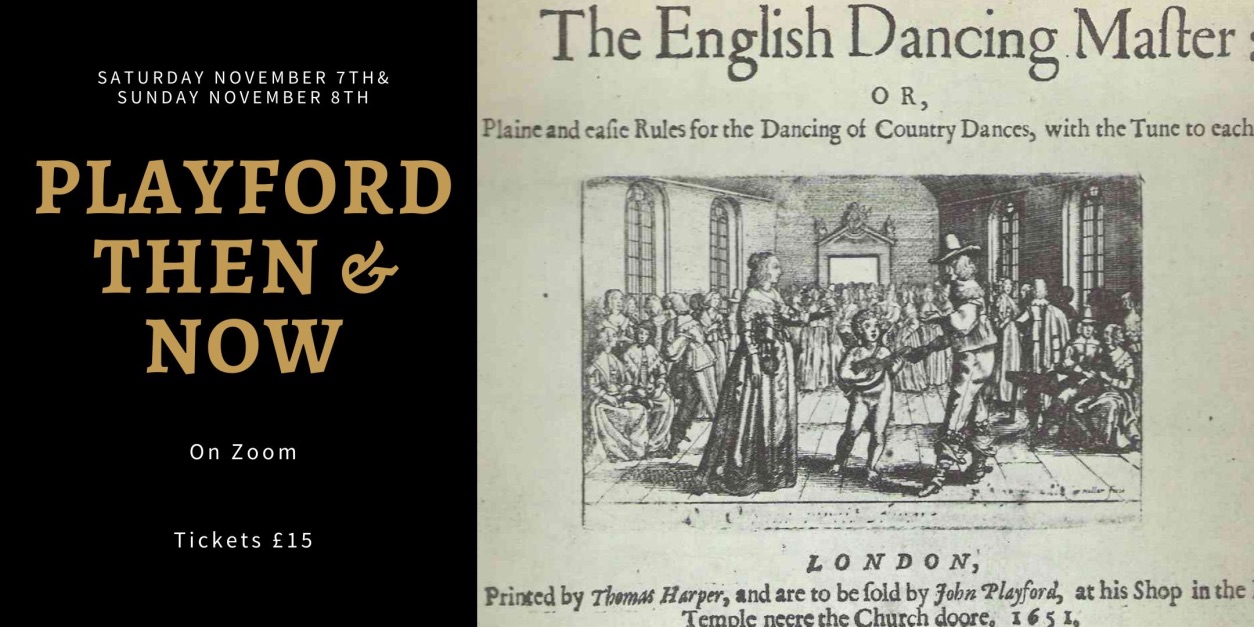
Playford – The ‘Why’ and ‘How’ of his continuing success today through dances, bands, his London, his contemporaries, and choreography
About this Event
Following the success of the HDS Webinar Talks and the Online Dance Tutorials – both of which can be found on our YouTube channel – we’re delighted to announce the HDS Playford Weekend Festival – Playford, Then and Now. The enduring popularity of Playford dances and their music from the first edition published in 1651 to the 18th edition in 1728, is a treasure chest for folk dancers, historical dancers, musicians and researchers. Festival sessions will feature talks on a variety of related topics as well as a dance workshop, with renowned speakers from the UK and overseas.
Saturday 7th November 2020
Sunday 8th November 2020
Get your ticket from Eventbrite (opens in new window/tab).
Programme In Detail
Saturday 7th November 2020
12.05–13.05 Playford’s London
Speaker Tamsin Lewis
There is music for hundreds of dances in Playford’s publications (the multiple editions and volumes of The Dancing Master, and Apollo’s Banquet), and these include a large number named after specific places. Some, like St Martin’s Lane, Mayfair and Piccadilly are easily identifiable to us today. Others like Mulberry Garden and Millfield (now Buckingham Palace and Liberty’s) have changed beyond recognition. In my talk, I will use Playford’s dances to map out the London that Playford and his family knew.
Tamsin Lewis Tamsin studied violin at the Florence Conservatoire and read Classics and Italian at Oxford. She has written, arranged, directed and played music for many theatre productions, as well as her work for television and radio. She is a member of the Lions part Theatre Company providing music and costume for many of their productions, and frequently appearing in their festivals as a violin-playing bear. She has published a number of books with Rondo Publishing, and is currently working on a series of books on John Playford’s London.
13.15–14.15 The New and (possibly) Improved English country dance in the later 1600s
Speaker Ann Hinchliffe
The dances in Playford’s Dancing Master show radical changes after Charles II was restored to the throne in 1660. The talk will suggest how these were due to the newly-fashionable French culture, discuss steps and formation, and suggest how ‘English’ the dances still were.
Ann Hinchliffe
Ann has been a keen folk dancer since age seven, and later took up Morris dancing, barn dance calling and playing in ceilidh bands. Ann was always curious about the links between all these, so when as a young teacher (specialising in language) she saw Anne Daye’s course Introduction to Tudor Dance for Teachers, she leapt at it. That ignited a flame for historical dance, and she’s happily ended up researching, teaching in festivals, running historical dance groups, and editing the Historical Dance Society newsletter (with lots of cheerful help from fellow dancers).
14.25–15.25 Of Playford’s Contemporaries: Two Seventeenth-Century ECD Manuscripts at Harvard
Speaker: Aaron Macks
John Playford’s The English Dancing Master is obviously the most successful Country Dance manual of the 17th century and the only printed source of its kind to have survived to the present. Several fragments of handwritten manuscripts survive with dance instructions, but until twenty years ago, no large collections were known. Since then, however, two small booklets have surfaced in the Houghton Library at Harvard University, one from circa 1649 and the other from the late 1660s. This presentation will introduce these two manuscripts, their physical codicology and their content, both as stand-alone sources for English Country Dance and as evidence for traditions outside the Playford inheritance.
Aaron Macks
Aaron Macks is a systems architect with Harvard Business Review and a sometime teacher of country dance. In addition to publishing an edition of the Ward Dance Manuscript, he works on CoKL: Corpus Kalendarium, a digital tool for analyzing the devotional calendars in Books of Hours. His previous researches included automated parsing of Akkadian verb-forms and clustered supercomputing.
15.35–16.35 Interpreting and composing dances in the 21st century
Speaker Colin Hume
John and Henry Playford published dances in the 17th century. What is their relevance to the 21st century? What changes should we make to these dances to ensure their continued use, and what is the status of new dances composed in this style?
Colin Hume
Colin Hume has been interpreting country dances for over thirty years, and believes in being as faithful as possible to the originals while still producing versions which people will enjoy dancing. He also composes his own dances and tunes in various styles, and will explain his methods and philosophy. He is well-known in England and North America as a caller and dance writer, and his website colinhume.com contains a wealth of dance-related material.
16.45–17.45 Workshop: Contrasting styles of performance in the first edition
Speaker Charlotte Ewart
Should you hop or should you step? Should you skip or should you walk? We know what we are meant to be doing, but do we know HOW we are meant to be doing it? And HOW we do it, does matter. A quick search through the now plentiful clips on the web will see the same written steps performed in many different contrasting styles – sedate, lively, high status, low status.…
This workshop will examine how the same steps can be danced, performed and presented in different ways. It will explore the influence that the choice of music, instrument and tempo has on the ‘how’ and finally discuss the issues the choice of style raises taking in to account both the context of the time these steps were written and the time we are now dancing them in. Who danced them then and now, why do we dance them and does that effect the ‘how’?
Charlotte Ewart
Charlotte trained in classical and contemporary dance. She has a BA in History and Dance and an MA in Dance, and her thesis was researching and reconstructing the 13th century Estampie. Charlotte is a qualified teacher working across all age groups teaching Dance and Drama. Charlotte is currently an Associate Artist for Historic Royal Palaces, lecturer in performing arts at Crawley College and Period Dance teacher at the London Dramatic Academy. In her professional life Charlotte has worked with a wide variety of prestigious organisations including English Heritage, Bristol and Cambridge Universities, as well as Time will Tell Theatre, The History Channel and most recently a number of productions for the BBC, Britain’s Christmas Story with Gareth Malone, Danny Dyer’s Right Royal Family and A Merry Tudor Christmas with the historian Dr Lucy Worsley. In recent months Charlotte has transferred her skills online with HDS and other online dance conferences.
Sunday 8th November
12.05–13.05 What is a ‘Country’ dance
Speaker Dr Anne Daye
My talk will explore the country dance in its social and dance-historical contexts in order to tease out the essential features of this staple of English dancing. A set of questions will be raised. Why did the country dance emerge in the mid-sixteenth century? Why was this group of varied dances recorded by Playford 1651 known as ‘country’ dances? Why was it so successful for so long? Why did the French like it, and how did it affect their dancing? Who danced it? And finally how ‘English’ was it?
Dr. Anne Daye
Dr. Anne Daye is a dance historian who teaches, lectures and publishes widely. Formerly Chairman, she is now Director of Education and Research for the Historical Dance Society. Her special field is the Tudor and Stuart masque in the context of Renaissance dance in France, Italy and Britain. This talk arises from current research into dancing in the age of Jane Austen.
13.15–14.00 A Dance Band for Playford
Speaker Jeremy Barlow
‘A Dance Band for Playford’ examines the the kind of line-up that would have played for balls that included country dancing in the 17th and 18th centuries. The session will start with images and then go on to recordings of groups playing Playford on original instruments, to see if they follow the iconographic evidence.
Jeremy Barlow
Jeremy Barlow has been interested in Playford’s country dances since he founded the Broadside Band in 1979. He has made many recordings featuring Playford material, and his edition The Complete Country Dance Tunes from Playford’s Dancing Master, 1651-c.1728 has been in print since 1985.
14.10–15.10 A Song for ‘Jamaica’
Speaker Susan de Guardiola
In the century and a half since William Chappell identified half a dozen songs and ballads associated with the tune ‘Jamaica’, published in the fourth through eighteenth (1670-1728) editions of Playford’s The Dancing Master, his conclusions have been both uncritically accepted and sternly disputed without any particular new evidence either way. Recent discoveries and advances in ballad cataloguing permit both a reexamination of the common assumptions about connections between these songs and associated tunes and dances and the identification of unresolved questions and approaches for further study.
Susan de Guardiola
Susan de Guardiola (BA, Yale University; MSEd, University of New Haven) is an independent scholar in social dance history who pre-pandemic divided her residence between the USA and Russia. She has presented her work at conferences and dance festivals including the Historical Dance Society’s On Common Ground, the International Congress for Medieval Studies, and Stanford University Historical Dance Week. In 2013-2014 she conducted research at Harvard University as a New England Regional Fellow. Her research interests extend from the 15th century through the early 20th century and beyond the ballroom to the social and cultural contexts of social dance and its connections with music, literature, and theatre.
15.20–16.20 The Fallibroome dances from Bernard Bentley
Speaker Martyn Harvey
In the Fallibroome Collection, Martyn will take a look this legacy from Bernard Bentley and his booklets published between 1962 and 1980. It will include some background on Bernard Bentley, explanations and demonstrations. In an hour I’ll probably have time to cover just a couple of the dances certainly ‘Huntington’s Maggot’. There will be some work on the timing of moves so that dancers reach the position that they should reach in time with the music, and also ensuring that you’re facing the direction you need to be facing in readiness for the next move – an art in itself. All this interspersed with the opportunity to get up and actually dance. That gives dancers the challenge to put these points into practice with a view to making the music visible!
Martyn Harvey
Martyn grew up experiencing the tutelage of lauded names such as Tom Cook, David Anderton, Ken Alexander and Nibs Mathews between 1973 and 1986. During those formative folk dance days he found that he identified closely with Bernard Bentley, the author of the 6 small booklets publishe. Martyn’s an out and out dancer who has always looked to listen to the music and its phrasing and believes that these dances deserve to be danced with style, feeling and a sense of joy.
16.30–17.30 Playford, the Player: Choreographic Concepts as Dramatic Dance
Speaker Darren Royston
How can Playford’s English Dancing Master offer instruction to drama students training in the art of movement? What can this dance form teach about spatial awareness, narrative development, and social interaction? What inherent meanings can be extrapolated from the steps, syntax, and structure of published movement patterns? What happens when social dances are placed in the context of drama: for example, in theatre, TV and film? What concepts can be used choreographically to create an aesthetic style, establish semiotic signifiers, or suggest sexual politics on the dance floor?
Darren Royston
Darren Royston works internationally in theatre, opera, film and TV as a choreographer, movement director, dance consultant and director. First studying dance in Shakespeare at Cambridge University, he received a distinction award in Dance Studies from Trinity Laban, before training in early dance with many of the leading teachers in the UK, Europe and USA, including being mentored by choreographers Geraldine Stephenson and Gillian Lynne. Having become assistant to Peggy Dixon, he was appointed artistic director of Nonsuch History & Dance in 2005, and continues to teach and mentor students, working for two decades at drama schools and music colleges such as London’s Royal Academy of Dramatic Art (RADA). In the UK, Darren has been appointed dance consultant at the National Theatre, the Old Vic, Royal Shakespeare Company, and choreographed for many theatre and opera companies. Publications include Dramatic Dance- An Actor’s Approach to Dance as a Dramatic Art (Bloomsbury Methuen RADA).
Tickets at £15 for the whole or part of the weekend from https://www.eventbrite.co.uk/e/playford-then-now-festival-tickets-12107…